

Limitless · CBS · 2015–2016
Limitless — storytelling at television speed
A network series shot on New York locations, where the visual effects were built as part of the show's storytelling grammar rather than as spectacle.
In brief
- Production
- Limitless · CBS · 2015–2016
- Leadership involved
- Doug Aarniokoski — Director and executive producer on the series; directed the season finale; Jason Zimmerman — Visual effects supervisor on the series
- The problem
- A network drama with a full-season order had to put the audience inside a character's altered perception every week, on an episodic schedule, while shooting out in a city that does not stop for a film crew.
- The approach
- The visual effects were designed as a language for thought rather than as set pieces. Jason Zimmerman described the work as effects that sit in front of the audience but are used differently: graphical, dynamic imagery that helps you understand what is happening inside a person's head.
- The result
- A recognisable visual grammar for the character's cognition that could be produced repeatedly across a network season.
- A production able to keep shooting out in New York while sustaining that visual identity, with Aarniokoski acting as the on-the-ground creative and production authority for a Los Angeles-based writing and post operation.
- Effects work developed as an extension of camera, editorial and performance rather than as a separate post deliverable.
- The lesson
- Effects are a storytelling language, not a deliverable category.
Summarised from the sourced detail below. Full narrative and attribution follow.
Antique Robots team members involved
Doug Aarniokoski
Director and executive producer on the series; directed the season finale
Jason Zimmerman
Visual effects supervisor on the series
This production predates Antique Robots. It is listed as production experience carried by the people named above, not as work produced by the company.
The challenge
A network drama with a full-season order had to put the audience inside a character's altered perception every week, on an episodic schedule, while shooting out in a city that does not stop for a film crew.
Doug Aarniokoski described the working reality plainly in interview: the production shot in New York while the writers, editors and senior producers worked in Los Angeles, and the days ran on overlapping tracks — shooting one episode while prepping the next.
The approach
The visual effects were designed as a language for thought rather than as set pieces. Jason Zimmerman described the work as effects that sit in front of the audience but are used differently: graphical, dynamic imagery that helps you understand what is happening inside a person's head.
On the production side, New York was treated as a character in the show, the way it had been in the feature. Standing sets carried the recurring interiors; the rest of the show went out into the city, which Aarniokoski described as the harder and more valuable choice on a television schedule.
The process
Sequences were originated by the filmmakers and then engineered. The opening push through the eye into a synaptic view came from director Marc Webb's pitch and was built as a full CG interior of the brain by Origin Digital Studios, cut against a macro plate of the actor's eye.
Camera solved as much as post did. The library sequence with twelve versions of the same character was shot motion-control on a second-unit day; the fractal zoom look was researched with the department that created it for the feature and then shot with cinematographer Jonathan Sela using a three-camera Alexa array across locations, with the plates joined and pushed digitally.
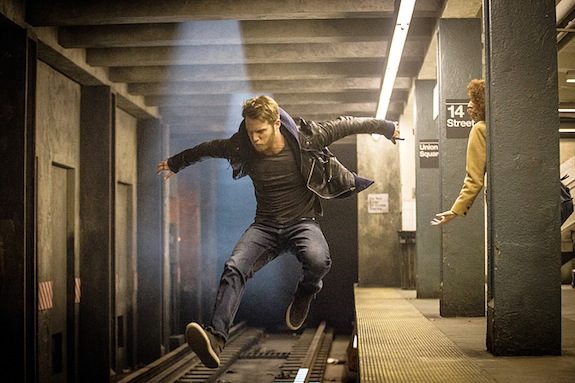
Other beats were pure production craft: a locked-off plate with frames removed to show several simultaneous versions of the character, a family-tree pull-back shot at one frame per second and then reversed into a 24fps push, and a subway train front built onto a vehicle chassis running on track so the station work could be photographed for real.
Directing, producing and effects supervision ran alongside each other rather than in sequence — the show's visual identity had to survive changing directors, a moving location schedule and a bicoastal producing structure.
What it enabled
- A recognisable visual grammar for the character's cognition that could be produced repeatedly across a network season.
- A production able to keep shooting out in New York while sustaining that visual identity, with Aarniokoski acting as the on-the-ground creative and production authority for a Los Angeles-based writing and post operation.
- Effects work developed as an extension of camera, editorial and performance rather than as a separate post deliverable.
Why it matters to Antique Robots
Limitless is the clearest early example of how this leadership works: the picture decides the method. Some of the show's most distinctive imagery was solved with a motion-control rig, an intervalometer and a vehicle chassis, and some was solved with a full CG environment. Nobody argued for a discipline; they argued for the shot.
It is also a working model of episodic leadership — a director-producer holding the creative line on location while the rest of the machine runs elsewhere.
Key principles
- Effects are a storytelling language, not a deliverable category.
- Decide practical versus digital per shot, not per show.
- Location work is harder and usually worth it.
- Somebody senior has to own the creative line on the floor.
Sources
Direct interview · fxguide
Limitless goes on a trip to the small screen
Ian Failes · 28 September 2015 · Jason Zimmerman, VFX supervisor
https://www.fxguide.com/quicktakes/limitless-goes-on-a-trip-to-the-small-screen/Direct interview · Impact Online
Exclusive: From NZT to NYC — why Limitless is pushing boundaries (part two of a two-part interview)
circa April 2016 (no printed byline date; retrieved via the Internet Archive) · Doug Aarniokoski, director and executive producer
http://www.impactonline.co/television/9723-limitless-interview/